
House Slab Types for Ipswich Homes

Choosing the right house slab for your Ipswich property depends on what the soil testing reveals and what your engineer recommends. There’s no one-size-fits-all solution when you’re dealing with reactive clay, so here’s what you need to know about your options.
Waffle Pod Slabs
This is the most common slab system we install in Ipswich, and for good reason. Waffle pod slabs use polystyrene pods (they look like upside-down waffle makers, hence the name) that create void spaces under the slab. These voids give the clay room to move and swell without pushing up on your concrete, which is exactly what you need when building on reactive soils. They’re also lighter than conventional slabs, putting less pressure on unstable ground.
Stiffened Raft Slabs
When soil testing shows highly reactive clay—Class H or extreme Class M conditions—your engineer might specify a stiffened raft slab instead. These are thicker, heavily reinforced slabs with deep edge beams that essentially float on top of the soil. They’re engineered to move as one solid piece rather than crack under ground movement. You’ll see these more often on hillside blocks around Ipswich or properties with particularly challenging soil reports.
Conventional Slabs
Less common in Ipswich these days, but still used on stable soil sites. If you’re one of the lucky few with good ground conditions, a conventional slab might be suitable and more economical.
Your engineer makes the final call based on geotechnical testing—we just make sure it’s built exactly to their specifications.

Engineering & Soil Testing Requirements
You can’t just guess when it comes to house slabs in Ipswich—you need proper engineering, and that starts with knowing what’s actually under your block.

The House Slab Construction Process
Once engineering’s approved and council’s given the green light, here’s how we actually build your house slab from the ground up.
Site Preparation
We start by clearing and levelling your site, then compacting the ground to create a stable base. If your soil report calls for it, we’ll import better quality fill and compact that too—this is especially common on cut-and-fill blocks around Ipswich. Everything gets laser-levelled because even small variations now mean big problems later.
Formwork & Boxing
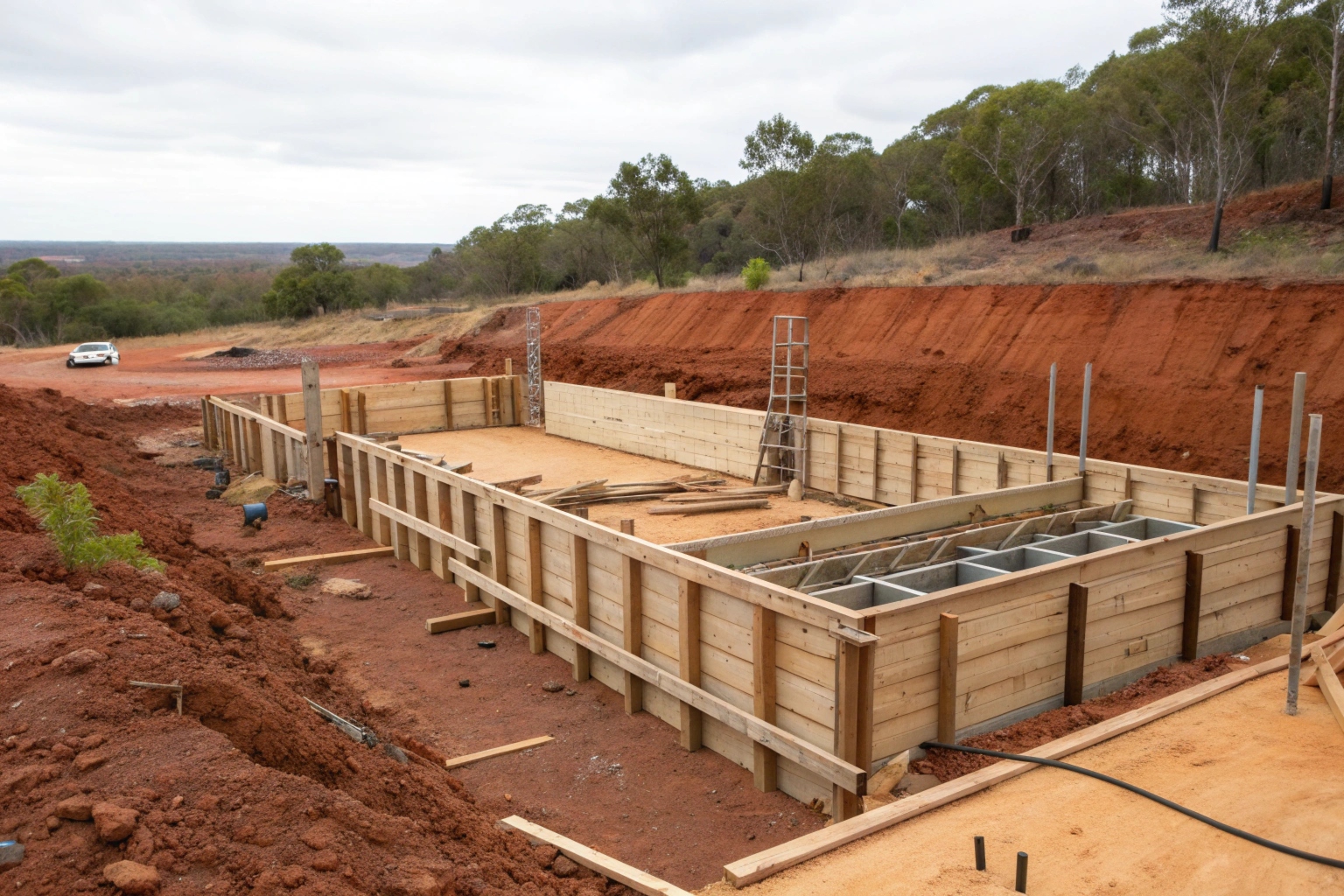
Next comes the formwork—timber or steel boxing that creates the shape of your slab and holds everything in place during the pour. We set this dead level and exactly to the engineer’s dimensions. The edge beams (the thicker perimeter sections) get boxed deeper than the main slab area, sometimes down to 600mm or more depending on your soil classification.
Waffle Pods & Reinforcement
For waffle pod slabs, we position the pods in a grid pattern with specific spacing—your engineer’s plan shows us exactly where each one goes. Then comes the steel reinforcement: mesh for the slab itself, plus heavier bar reinforcement in the edge beams and any internal beams. Every piece of steel gets tied off properly and supported at the right height using bar chairs so it ends up in the middle of the concrete, not sitting on the bottom.
Plumbing & Electrical
Before we pour, plumbers run all your under-slab pipes—stormwater, sewer, and water supply lines. Electricians install any conduits needed for power or data cables. Everything gets pressure tested and inspected.
Quality Indicators of a Properly Built House Slab
Not all house slabs are created equal, and when you’re investing in your new home’s foundation, you need to know what separates quality work from cutting corners.
Proper Curing Process
Concrete doesn’t dry—it cures, and that process takes time. We keep your slab moist for at least seven days after pouring, usually with wet hessian or curing compound. Rush this and the concrete won’t reach full strength, which means potential cracking down the track. In Ipswich’s heat, proper curing is even more critical because the concrete can dry out too fast if it’s not protected.
Correct Reinforcement Placement
Your steel needs to be in the right spot—not sitting on the ground, not poking through the top. We use bar chairs to hold mesh and rebar at the exact height specified by the engineer. When you walk across the site before the pour, you should see steel properly supported and tied off, not sagging or touching the formwork.
Edge Beam Specifications
The edge beams are your slab’s strength, especially in reactive clay. They need to be the right depth, with the right amount of steel, poured monolithically (all at once) with the rest of the slab. We’ve seen slabs fail because someone skimped on edge beam depth to save a bit of concrete—that’s false economy that costs way more to fix later.
Smooth Finish & Proper Fall
A quality slab is smooth and level where it needs to be, with proper fall (usually 1:100) toward drainage points. No birdbaths, no high spots that’ll cause problems when your builder starts framing.
Frequently Asked Questions About House Slabs Ipswich
From site prep to being ready for your builder, expect about 2-3 weeks for a standard house slab. That includes formwork, steel placement, plumbing rough-in, the concrete pour, and the seven-day curing period. Weather can extend this—wet conditions delay pours, and extreme heat affects curing, so timing matters when you’re scheduling construction.
Yes, your slab needs Ipswich City Council approval before we pour. Your builder or engineer submits the slab design and soil report as part of the building approval process. Council inspects at key stages—before pour and after—to make sure everything meets the Building Code of Australia and local requirements.
Waffle pod slabs use void formers (pods) to create air gaps that let reactive clay move without affecting your slab. Raft slabs are solid concrete that’s heavily reinforced to move as one piece. Your engineer chooses based on your soil classification—more reactive clay usually means raft slabs.
Costs vary based on slab size, soil conditions, and complexity, but expect anywhere from $15,000-$35,000 for a typical Ipswich home. Highly reactive soils requiring deeper footings and more reinforcement cost more. Get your soil test done first—that tells us what’s actually needed.
Get Your House Slab Built Right the First Time
You’re making one of the biggest investments of your life, and your home’s foundation deserves contractors who understand Ipswich’s soil challenges inside and out.
At Total Concrete Ipswich, we’ve been building house slabs on reactive clay for years, working with structural engineers and builders across Springfield, Redbank Plains, Booval, Bundamba, and surrounding areas. We know what Class H soils require, we know the council approval process, and we know how to deliver slabs that stay level and crack-free for the life of your home.
Whether your engineer’s specified a waffle pod slab or a stiffened raft system, we’ll build it exactly to their design—with proper reinforcement placement, adequate footing depth, and the curing time your concrete needs to reach full strength. No shortcuts, no cutting corners, just quality workmanship that gives you confidence in your new home’s foundation.
Ready to discuss your house slab project? We offer free quotes for new home slabs across the Ipswich region. Give us a call or fill out our online form, and we’ll arrange a time to review your plans, soil report, and engineer specifications. Let’s make sure your new home starts with a foundation built to last.
Contact Total Concrete Ipswich today – because getting your house slab right the first time is a lot cheaper than fixing it later.
