
Types of Concrete Foundations We Install in Ipswich

Not all concrete foundations work the same way, and what’s right for your project depends on your soil test results, building design, and site conditions. We install several different foundation systems across Ipswich, each engineered for specific situations.
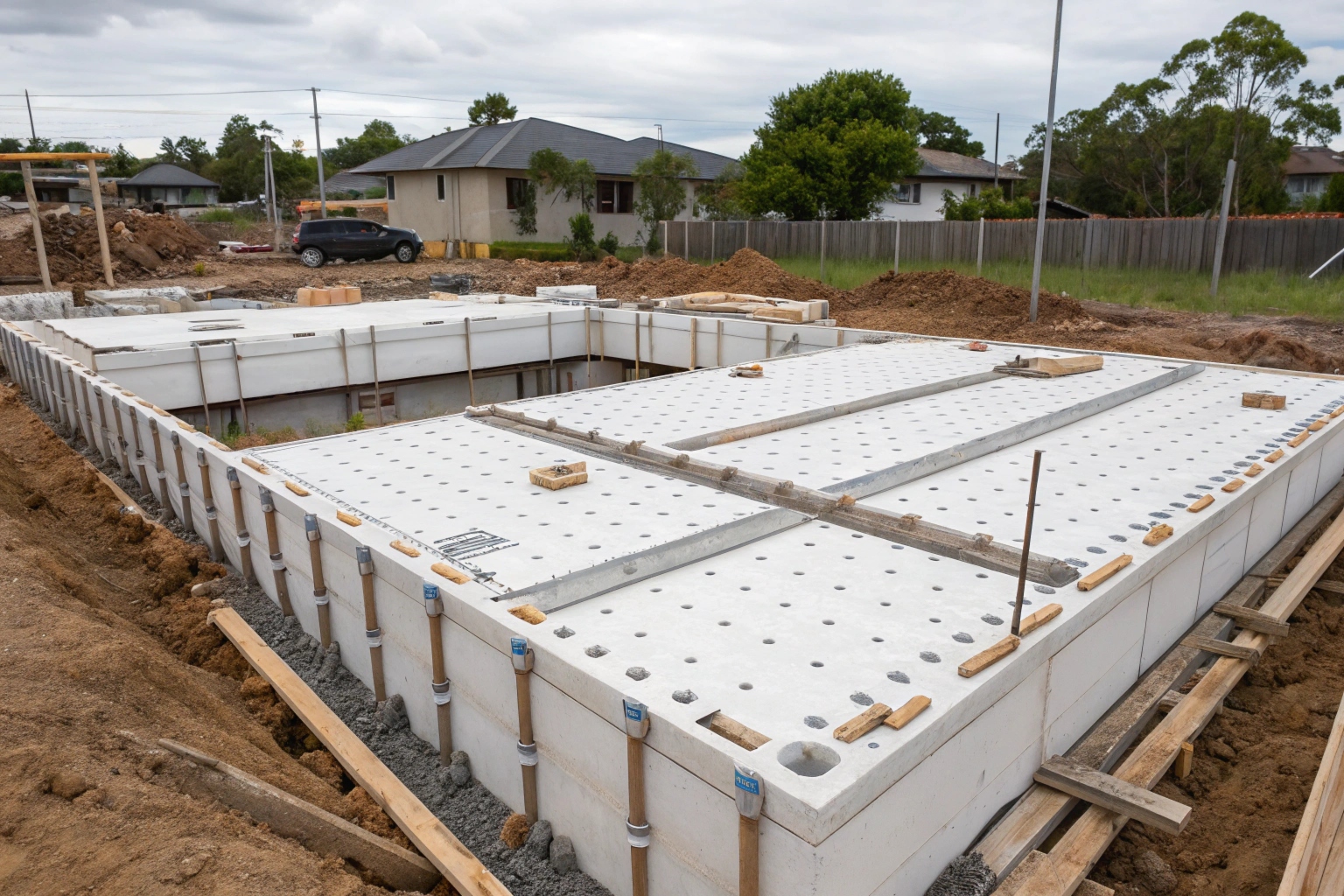
Slab foundations are the most common for residential builds in Ipswich. Waffle pod slabs use a grid of polystyrene pods to create a lighter foundation that handles soil movement better than traditional thick slabs. Raft slabs work well on extremely reactive soils because they spread loads across a larger area and can move slightly as a unit without cracking.
Strip footings support the external and load-bearing walls of your building. These concrete beams sit on deeper, more stable soil layers and transfer the building weight down to where ground movement is less extreme. They’re often combined with a suspended floor system for homes on sloping sites or areas with poor drainage.
Pier and beam foundations use concrete piers driven down to stable soil, with beams connecting them to support the floor structure above. This system works well on challenging Ipswich sites with highly reactive clay or significant slope. The piers go deep enough to reach soil that doesn’t move with seasonal moisture changes.
Concrete footings for stumps are still used for some Queenslander-style homes and pole buildings. Each stump sits on a concrete footing that’s sized and reinforced according to the load it carries and soil conditions at that specific location.
Your engineer will specify which foundation type suits your site based on soil testing and building requirements – we install whichever system gives your building the stability it needs

Why Your Concrete Foundation Matters More Than You Think
Your concrete foundation isn’t just the bottom part of your building – it’s the entire reason everything above it stays level, square, and crack-free for the long haul. Get the foundation wrong and you’ll be dealing with problems for as long as you own the property.
Bottom line – every dollar spent on a properly engineered concrete foundation saves you ten dollars in repairs later. It’s the one part of your building you can’t go back and fix easily once construction’s finished.
Ipswich Soil Conditions and Concrete Foundation Requirements
Here’s what makes concrete foundations in Ipswich different – our soil moves more than almost anywhere else in Queensland. Class H and M reactive clays expand when wet and shrink when dry, sometimes shifting up to 100mm between seasons. That movement will crack any foundation that isn’t engineered to handle it.
Reactive clay engineering means your concrete foundation needs to be designed specifically for soil movement, not just built to generic standards. We’ve seen foundations crack within months because they were installed without proper consideration for Ipswich’s clay soils. The engineer’s specifications for your site will account for how much your particular soil moves based on test results.
Soil testing isn’t optional – it’s mandatory before any concrete foundation work starts. Tests determine your soil classification, which then determines everything about your foundation design. Depth of footings, thickness of slabs, amount of reinforcement – all based on what the soil report shows about your specific site.
Depth requirements for Ipswich foundations typically go deeper than other areas because we need to get below the active soil zone where moisture changes cause movement. Edge beams often extend 600mm or more down to reach stable soil layers. Strip footings can go even deeper depending on your engineer’s calculations.
Moisture management around your concrete foundation is critical in Ipswich. Proper drainage, moisture barriers under slabs, and grading that moves water away from foundations – these prevent the wet-dry cycles that cause our clay soils to heave and shrink. We install all the moisture protection your engineer specifies because we know what happens when you don’t.

What Goes Into a Properly Built Concrete Foundation
A concrete foundation is more than just concrete poured into a hole – there’s multiple components that work together to create a stable base for your building. Each part has a specific job, and missing or skimping on any of them compromises the whole system.
Footings and edge beams form the perimeter of your foundation and carry the bulk of your building’s weight down to stable soil. Edge beams in Ipswich typically run deeper than standard because of our reactive clays – your engineer specifies the exact depth and width based on your soil test and building loads.
Reinforcement steel (reo) gives your concrete foundation the strength to handle tension forces that concrete alone can’t manage. We’re talking about steel mesh in slabs, N12 or N16 bars in beams, and specific spacing requirements that your engineer calculates. Proper placement matters – reo that’s too high or too low in the concrete doesn’t do its job.
Moisture barriers go under slab foundations to stop ground moisture rising up through your concrete. This plastic membrane also prevents soil chemicals attacking your concrete from below. In Ipswich’s clay soils, moisture control is critical for foundation performance.
Termite protection gets built into foundations through physical barriers or treated zones, depending on your termite management plan. We install whichever system your plans specify at the concrete pour stage.
Service penetrations for plumbing, electrical, and drainage need to be positioned and sleeved correctly before concrete goes in – you can’t easily add them later.
Frequently Asked Questions About Concrete Foundations in Ipswich
Timeline depends on your foundation type and site conditions, but most residential slab foundations take 3-5 days from excavation to pour completion. Then you’re looking at minimum 7 days cure time before construction can continue – longer in cooler weather. Strip footings and pier systems can take longer depending on depth requirements for Ipswich’s reactive soils. We’ll give you accurate timeframes once we see your engineer’s plans and site conditions.
Yes – it’s not optional in Ipswich. Council requires geotechnical soil testing before they’ll approve foundation plans, and your engineer can’t design a proper foundation without knowing your soil classification. Ipswich has some of the most reactive clay soils in Queensland, and building without testing is asking for expensive structural problems later. The few hundred dollars for soil testing saves thousands in potential foundation failures.
Both handle reactive soils, but differently. Waffle pod slabs use a grid of polystyrene pods that make the slab lighter and allow for some ground movement without cracking – they’re common in Ipswich residential builds. Raft slabs are solid concrete that floats on the soil surface and moves as one unit. Your engineer specifies which type suits your soil conditions and building design – we install whichever system they recommend for your site.
Get Your Concrete Foundation Built Right in Ipswich
Ready to start your building project with a concrete foundation that’s engineered for Ipswich’s reactive clay soils? We work across Ipswich, Springfield, Redbank Plains, and surrounding areas, installing foundations that give your building the stable base it needs for the long haul. Contact Total Concrete Ipswich today for a quote on your foundation project.
